Amelia Fernandez
The Vampire Prince’s BrideAmelia Fernandez is the central human heroine of Her Two Wolves, a paranormal ménage romance about a woman seeking love and two werewolves seeking the human partner who will complete their Alpha triad. Her decisive significance lies in the way she crosses the boundary between ordinary human life and shifter society without surrendering her own preferences: Amelia is not merely selected by supernatural mates, but actively chooses a form of intimacy that answers her long-standing desire for devotion, stability, and emotional certainty.
Identity and Introduction
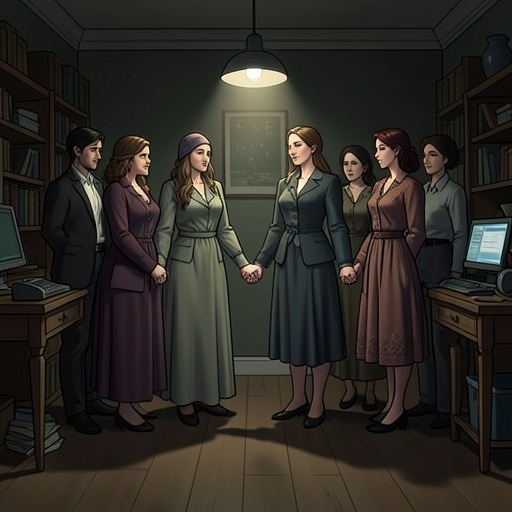
Amelia is introduced as an insurance broker with an unexpectedly enthusiastic attachment to office work. She loves the smell of ink toner, her personalized desk, the cubicle she calls her own, the constant noise of phones and computers, and even the view of a garbage bin in the alley. Her pleasure in this environment gives her an immediately distinctive character: she finds vitality in the most mundane features of bureaucratic life, treating the office not as a prison but as a small, dependable civilization.
That cheerful professional routine is interrupted by a difficult conversation with her brother Adrian. He criticizes her for being too demanding in her search for a partner and tells her that she must stop expecting a man to bow to her every whim. Amelia ends the call rather than continue the argument, silences her cell phone, and sends her work phone to voicemail. The incident establishes both her impatience with condescension and the pressure surrounding her romantic choices.
Her dissatisfaction is not casual. After years of choosing the wrong men, Amelia has reached thirty and feels the passing of birthdays as an uncomfortable measure of time. Three days before the story opens, she created a profile on a shifter dating website whose slogan is “Meet your one true mate.” The promise appeals to her because shifters are presented as physically powerful and utterly devoted to their mates. Compared with the exhausting human process of sorting through hundreds of contacts, the shifter system appears selective and purposeful: shifters contact only the woman they believe may be “the one.”
Life and Plot Trajectory
Amelia’s ordinary world is therefore defined by a striking contrast. She is comfortable with the practical, repetitive world of insurance claims, yet emotionally dissatisfied with the human dating market. Her profile becomes the bridge between those two spheres. Although she has received no messages at first, she understands that silence is part of shifter courtship rather than evidence of personal failure. A shifter does not flirt indiscriminately; he waits for a bond that seems meaningful. When contact finally arrives, it transforms her private experiment into the beginning of a new life.
The romance joins Amelia to Xavier Knight and Timothy Pond, whose relationship already functions as a werewolf partnership. They are not simply two competing suitors. They approach Amelia as the woman who can complete their Alpha triad, making the central romantic structure collective rather than exclusive. Amelia’s role is consequently more substantial than that of a prize exchanged between two Alphas: her acceptance makes the triad possible, and the relationship depends on her inclusion as a full partner.
The story’s movement resembles a love plot shaped by discovery and transformation. Amelia begins by seeking a single ideal mate through a specialized dating service, but she discovers that the answer to her desire is not one man but a committed three-person bond. The supernatural premise intensifies an ordinary emotional problem—how to find reliable love—while also revising the expected destination of romance. Her search does not end by restoring conventional human couplehood; it ends by making an alternative domestic structure emotionally legitimate.
Relationships and Commitment
Amelia’s defining relationships are with Xavier and Timothy. The two Alphas are already mated according to werewolf standards, but they still recognize that Amelia deserves the human ritual she has imagined for herself. This distinction matters: supernatural mating has already established their bond, yet they do not treat that bond as sufficient reason to dismiss Amelia’s cultural expectations. They make room for the human tradition of marriage because they understand that commitment must be expressed in a form meaningful to her as well as to them.
Their proposal is carefully symbolic. Xavier and Timothy kneel together and present two small velvet boxes. Inside are two thin rings, one gold and one silver, designed to interlock once placed on Amelia’s fingers. The rings materialize the structure of the triad: neither relationship is erased, and the two commitments become part of a single joined pattern. The gesture also answers the earlier frustration of Amelia’s dating life with visible, deliberate certainty.
Amelia responds with overwhelming joy. She tackles both men, kisses them in turn, and accepts without hesitation. Her tears and repeated yes make the proposal more than a ceremonial conclusion. They show that the marriage fulfills a desire she has been trying to conceal while planning the wedding in her imagination. The scene confirms that Amelia has not merely been swept into a supernatural arrangement; she has been hoping for its emotional security and recognizes it when Xavier and Timothy offer it.
Human and Nonhuman Boundaries
Amelia’s characterization gains meaning from the wider collection’s recurring interest in mixed identities, bodies, and species. Her relationship with Xavier and Timothy places a human woman inside a werewolf social structure, while other stories in the same collection examine bionic eyes, interspecies pregnancy, altered DNA, and magical inheritance. Against that background, Amelia’s romance participates in a larger reworking of the boundary between human and nonhuman life.
The relationship is nevertheless grounded in choice rather than biology alone. The shifter dating website turns mate selection into a point of contact between species, but the website does not replace personal consent or emotional recognition. Amelia begins with a fantasy of shifter devotion, then encounters particular people whose commitment gives that fantasy a concrete form. Her humanity remains important precisely because the relationship must accommodate her expectations about marriage, rings, and ceremony.
This also gives the romance a market-shaped irony. Amelia first approaches love through a specialized dating platform, comparing the efficiency of selective shifter contact with the exhausting abundance of human messages. The language of profiles, contacts, compatibility, and finding “the one” makes intimacy resemble a search process. Yet the proposal resists reducing the result to a successful transaction. The interlocking rings and the shared kneeling scene turn an online introduction into a reciprocal promise that exceeds the dating mechanism that initiated it.
Change and Narrative Role
Amelia changes from a woman defending her standards against family criticism into a woman whose unconventional standards are affirmed. Adrian tells her to compromise, but the romance does not portray fulfillment as the abandonment of her wishes. Instead, Amelia finds partners who meet her need for devotion while expanding the form that devotion can take. Her apparent pickiness is reinterpreted not as a defect but as evidence that ordinary matches had failed to provide what she wanted.
Her final acceptance also completes the Alpha triad that defines the story’s premise. Xavier and Timothy begin with an established two-person bond and seek the partner necessary to make it whole; Amelia begins outside their supernatural society and enters it through deliberate recognition. The plot therefore moves in both directions at once: the Alphas gain the missing member of their family, while Amelia gains the committed partners and future she had been unable to find through human dating.
Amelia’s ending is an engagement and an emotional home rather than a solitary victory. The two rings, gold and silver, interlock on her fingers, making visible the principle that governs her new life: the relationship is strongest not because one bond defeats another, but because multiple bonds are joined without being made identical. Her story gives the collection its clearest romance of chosen belonging, presenting the human heroine as the agent who completes, reshapes, and publicly validates the triad.